Beaumont Pottery
Old World Craftsmanship
From the preparation of our clays and glazes to the turning, trimming, glazing, and firing, our processes are rather primitive. Slight variations and spots are just that. If you find a problem with your purchase, we will be glad to take care of it.

Step 1
Making our clays
Our clay is extracted from the ground locally in Maryland. It is the first raw ingredient that we start with. The type of clay and how it is prepared effects the final characteristics of the pottery, such as color texture, and durability. There are many steps that go into the process of turning dirt into smooth clay.

Step 2
Throwing & Trimming
Wheel throwing requires a combination of skill, precision, and artistic intuition. The clay is first centered on the wheel, second the clay is opened, third the walls are pulled up, and fourth the shape is created.
Step 3
Bisque Firing
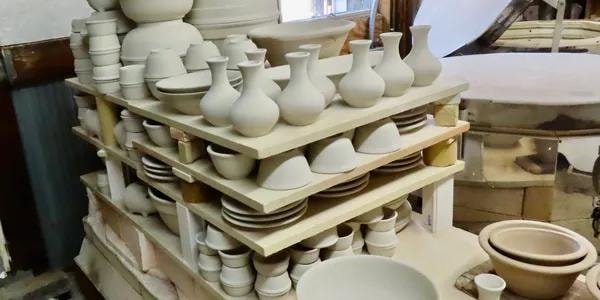
Before bisque firing, clay objects need to be thoroughly dried to remove moisture and prevent cracking in the kiln. Bisque firing is between 1700–2000 degrees fahrenheit. The clay undergoes chemical changes during bisque firing, resulting in a harder and more resilient pottery.
Step 4
Glazing
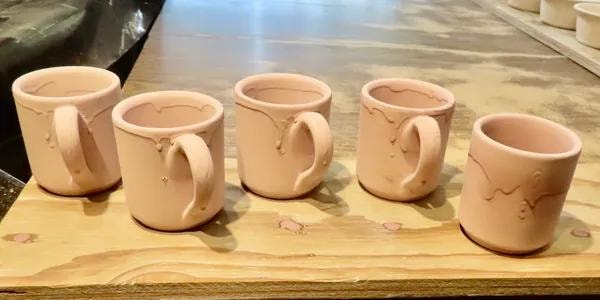
At Beaumont Pottery we formulate our glazes by hand. Measuring raw ingredients to the gram until we achieve the colors we dream of. Ceramics are hand dipped and sprayed individually.

Step 5
Glaze Firing
The beauty of the glaze only reveals itself after being transformed by the heat. Glaze firing is around 2,000 degrees fahrenheit. Every kiln you open is like Christmas morning. The big reveal is always full of beautiful surprises.